Join us and Chef Gregg Ciprioni of Garces Trading Company to celebrate the close of the 2011-2012 concert season with an evening of great music and great food. Beginning with “Songs to the Midnight Sun,” we’ll explore the evocative and haunting sounds of the northern summer, including works by Thomas Tallis (1505–1585), Einojuhani Rautavaara (1928–), [...]
We’re way excited for “This Green and Pleasant Land” on Sunday, March 11 at 2 PM at the First Unitarian Church, and the fact that admission is free with canned goods for Philabundance is only one reason. Here’s another:
If you’re curious about the program, get a head start on the program notes under the “Concerts” tab above. We can’t wait to see you soon!
Join us on Sunday, March 11 at 2 PM for This Green and Pleasant Land, featuring musical conceptions of paradise.
We’ll be celebrating the arrival of spring by roaming through the green grass of local and celestial paradises. Sacred composers have long exalted the promise of joys in the afterlife, but no music-lover can deny the appeal of more sensual, earthly pleasures. Featuring works by William Billings (1746-1800), Ralph Vaughan Williams (1872-1958), Samuel Barber (1910-1981), and Naomi Shemer (1930-2004), we traverse this spectrum of delight and exaltation, staking our support for our own fair city with a food drive for Philabundance.
The concert will be held at the First Unitarian Church at 2125 Chestnut Street. Free admission, but please bring canned goods for Philabundance.
We had a great time at Axis of Medieval this weekend, and we’re glad we were able to share our work with so many friends and supporters. If you missed it–or if you just want to re-live the experience–here’s a snippet:
Three Psalm Tunes from Archbishop Parker’s Psalter, Thomas Tallis
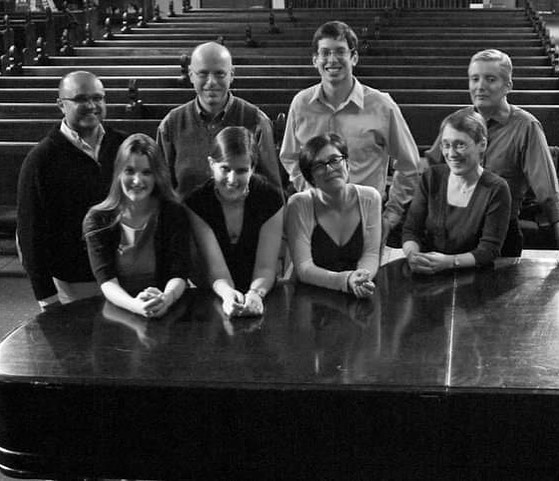
The Chestnut Street Singers, Philadelphia’s only cooperative chamber chorus, will perform a free concert entitled Axis of Medieval on Sunday, November 6 at 2 PM at the First Unitarian Church of Philadelphia. Last spring, Tom Purdom of The Broad Street Review lauded the ensemble’s inaugural season, heralding its “strong voices, good harmony, close coordination, and astute selections.”
This sophomore year will begin with the highlights of the so-called “Dark Ages.” Reaching back to the very origins of polyphony, Axis of Medieval will feature quintessential early works—both those whose composers have been lost to time and those by such familiar names as Guillaume de Machaut (1300–1377) and Thomas Tallis (1505–1585)—and their contemporary counterparts, ranging from Samuel Barber (1910–1981) to Abbie Betinis (1980–). The program draws from a vast range of sources—sacred and secular music spanning a millennium and several countries—but we hear echoes across the centuries, bringing medieval chant and contemporary art song into the same voices and the same spirits.
Tom Purdom, classical music reviewer for the Broad Street Review, writes, “Good a cappella choral music requires strong voices, good harmony, close coordination, and astute selections. The Chestnut Street Singers scored in all four categories.”
NEW VOICES IN TOWN
Tom Purdom
Published June 20, 2011
The Chestnut Street Singers comprise a 12-voice “cooperative chamber chorus” that presented its debut concert at the beginning of this season. I missed the Singers’ first two concerts, but their third event indicated that they’re another example of the creative ferment of Philadelphia’s music scene.
Good a cappella choral music requires strong voices, good harmony, close coordination, and astute selections. The Chestnut Street Singers scored in all four categories. Their voices all sound good together, and the individual voices made an impression every time someone launched into a brief solo.
The program featured music by a roster of American composers that ranged from the 18th-Century father of American choral music, William Billings, to 31-year-old Abbie Betinis. Every entry made heavy use of counterpoint as well as the other musical devices that substitute for the color and variety instruments add to accompanied choral music.
In a good a cappella choral setting, the composer’s musical embellishments and complexities perform two functions simultaneously: They enhance the mood of the text, and they create music that would be interesting and appealing if you didn’t understand a word the singers were singing. Most of the selections on the program met that test.
Clear female voices
The opener, Long Time Traveler, provided an effective preview of coming attractions. The arrangement by choir member Jordan Rock was a rearrangement of two versions: the original four-part arrangement published by Edmund Dumas in 1859, and a modern three-part arrangement by a Canadian folk trio, The Wailin’ Jennys.
Rock’s rearrangement included an evocative opening by a trio of exceptionally clear female voices; two complex arrangements of the rest of the text; and a lively interlude in which the whole chorus sang the melody in the four syllables used in the 19th-Century teaching technique called “shape note singing.”
From Copland to Garcia Lorca
The rest of the program included four religious motets by Aaron Copland; Billings’s moving setting of They that go down to the sea in ships; British composer Michael Tippet’s powerful, highly embellished 1941 settings of Steal Away and Nobody Knows the Trouble I’ve Seen; and a setting of a Garcia Lorca poem by the contemporary American choral master Eric Whitacre.
Abbie Betinis’s Long Time Traveling brought the afternoon to a close with a piece that lifted texts and melodies from three 19th Century shape note songs and transformed them into another rousing exercise in relevant complexifying.
The Chestnut Street Singers’ first concert of the 2011-12 season is called “Axis of Medieval,” and it’s scheduled for November 6. If this concert was typical of their work, they should become a favorite with the kind of audiences that Lyric Fest has been attracting to its art song programs.
We’re scheduling auditions for singers of all voice parts who are interested in joining us for the 2011–2012 season.
You might be right for us if you:
+love to sing challenging and exciting music;
+love to work collaboratively;
+have a flexible, well-trained voice, capable of singing in many different styles and with varying amounts of vibrato; and
+like to have fun with your choirmates.
We’ve got some exciting things planned for next year, beginning with Axis of Medieval, which will explore the origins of modern music and the way that early polyphony influenced what followed. Our concerts in March and May will feature the music of Spain and the Spanish New World and a journey to musical conceptions of Jerusalem and similarly idealized places. Along the way, we’ll continue our innovative work of holding accessible, exciting concerts and engaging with both arts and philanthropy in Philadelphia.
If you’re interested in learning more, email us at chestnutstreetsingers at gmail dot com and we’ll schedule a time to meet later this summer. We’re looking forward to singing with you!
Join us on Sunday, June 12 at 5 PM for I Hear America Singing, an exploration of American song traditions and American composers.
The performance will explore American song traditions and their place in American conceptions of travel and departure. Taking on a range of genres from shapenote to spirituals, the program juxtaposes traditional eighteenth- and nineteenth-century works with modern reinterpretations by Eric Whitacre, Abbie Betinis, and Aaron Copland. Given the American legacy of adventure and itinerancy, these pieces are firmly rooted in a culture that cherishes both the promise of new beginnings and the bittersweet pull of familiar places.
The concert will also feature the premiere of a new work by composer John B Hedges, who completed his postgraduate studies at the Curtis Institute of Music. Landis Settings, a three-part work set to poetry by Curtis Professor Emerita Joan Hutton Landis, hearkens back to the music of the 1940s and incorporates modern atonality made popular by Schoenberg, achieving what Hedges referred to as “a bluesy, juicy jazz harmony vein.” Hedges, recently named the Fort Worth Symphony’s composer-in-residence for the 2011–2012 season, is currently on the faculty at SUNY New Paltz, where he lectures at the School of Fine and Performing Arts.
"Listening to the Chestnut Street Singers' beautifully blended voices and tight formations in dynamic ebbs and flows in the music was a joy. Based on themes for past and future concerts, it appears that the excellent programming in this concert is not a fluke."
--Sharon Torello, Local Arts Live
"Good a cappella choral music requires strong voices, good harmony, close coordination, and astute selections. The Chestnut Street Singers scored in all four categories."
--Tom Purdom, Broad Street Review
Mark Your Calendar
Axis of Medieval
A millennium of music distilled from the earliest echoes of polyphony. Sunday, November 6 at 2 PM
This Green and Pleasant Land
Conceptions of Jerusalem and other earthly paradises. Sunday, March 11 at 2 PM
Songs to the Midnight Sun
A journey through the sunlit lands of the far north, followed by a prix fixe dinner with the singers from Chef Gregg Cipriani of Garces Trading Company. Sunday, May 6 at 5 PM
All performances will take place at the First Unitarian Church at 2125 Chestnut Street.